The Last Fare: The Cruel, Cold Case of Kenneth Hearn
Adelaide is a city praised for its vibrant culture, stunning churches, and picturesque parklands. But if you scratch beneath the surface of South Australia’s capital, you find a history punctuated by some of the most haunting criminal mysteries in Australian history. Long before the nation was gripped by the horrors of the Beaumont children’s disappearance or the dark cloud of the Family Murders, a quiet tragedy unfolded on the city’s fringes—one that has been met with 70 years of absolute silence.
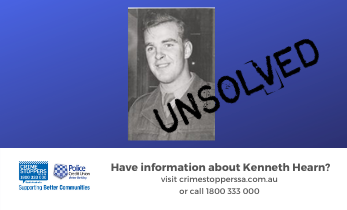
It is the story of Kenneth Hearn. A young man, an ordinary night shift, and a final fare that led to an execution.
In Episode 2 of Static After Dark, we are shining a light into this pitch-black corner of Adelaide's past.
A Hardworking Young Man in a Different Era
To understand what happened to Kenneth Hearn, you have to look back at Adelaide in May 1956. Post-war Australia was booming, suburban neighborhoods were expanding, and communities were tight-knit. It was a time when people left their back doors unlocked.
Kenneth was just 21 years old. Hardworking and reliable, he lived with his family on Humphries Terrace in Woodville Gardens and drove a cab for the St Georges Taxi Company. In the 1950s, driving a taxi was an essential service for a growing city, but it was also a vulnerable one. Drivers worked alone in the dead of night, carried cash, and trusted the strangers who climbed into their back seats.
Friday, May 18th, started as just another routine shift for Kenneth. There were no warning signs. No indications that he was tracking toward a fatal encounter.
The Fatal Route
Sometime during that cold Friday night shift, Kenneth picked up a fare in Port Adelaide—a bustling, working-class hub of docks and warehouses. The passenger requested to go toward Salisbury, a route that would take Kenneth along the dark, semi-rural stretches of Golden Grove Road.
What happened inside that taxi remains a chilling mystery. Did Kenneth realize something was wrong? Was there an argument, or did the violence strike without warning?
What we do know is brutal: Kenneth was shot at close range with a .22 caliber bullet. It wasn't just a robbery gone wrong; it was an execution. The killer cleaned out Kenneth’s pockets, taking his cash and personal effects, and left the 21-year-old slumped over the front seat of his own cab like discarded cargo.
At 8:00 AM on Saturday, May 19th, a horrified passerby spotted the St Georges taxi parked on Golden Grove Road. Inside was a nightmare that would permanently shatter Adelaide's sense of mid-century security.
The Hunt and the Dead Ends
The police response was massive. Detectives launched a sweeping manhunt, interviewing more than 50 people within days of the discovery. They had the bullet, they had a clear motive of robbery, and they had a tight timeline.
But 1956 was an era long before DNA profiling, GPS tracking, or CCTV surveillance. Investigators were entirely dependent on old-fashioned detective work and eyewitness accounts. Because taxi drivers operate in isolation, no one had seen the face of the final passenger who climbed into Kenneth's cab in Port Adelaide.
Despite 50 interviews and endless late-night raids, the leads dried up. Weeks bled into months, months into years, and the file on Kenneth Hearn grew agonizingly cold.
The Shadow of "The Family"
Decades later, Kenneth’s name would resurface in a terrifying context. Between 1979 and 1983, Adelaide was paralyzed by "The Family Murders"—a series of horrific, highly organized kidnappings and killings of young men. While only one man, Bevan Spencer von Einem, was ever convicted, police long suspected a wider network of prominent individuals was involved.
Because of the unexplained nature of Kenneth’s death and the vulnerabilities involved, cold case investigators have occasionally probed whether a thread connects his 1956 murder to the dark underbelly that birthed the Family Murders decades later. Was Kenneth an early victim of a generational darkness in Adelaide, or was he simply the target of a ruthless, opportunistic thief?
Without a confession or a forensic breakthrough, we are left only with theories.
70 Years of Silence: A Family Denied Justice
We often treat true crime cases as puzzles to be solved, but behind the timeline of May 19, 1956, is a real human life that was violently stolen. Kenneth Hearn was a son and a brother. His parents went to their graves never knowing who executed their boy. His siblings grew up in the shadow of an empty chair and a mystery.
Whoever killed Kenneth Hearn has likely lived a full life, carrying a monstrous secret to their grave or harbouring it into old age.
70 years is a long time to keep a secret. But a crime of this magnitude has no expiration date.
Listen to Episode 2 Now
In this week's episode of Static After Dark, host Chris deconstructs the timeline of Kenneth's final hours, dives into the immediate aftermath of the police hunt, and explores the lasting impact this cold case left on the city of Adelaide.
🎧 Listen to "The Last Fare: The Murder of Kenneth Hearn" on Apple Podcasts, Spotify, Amazon Music, or wherever you get your podcasts.
Can You Help Solve This Case?
If you have any information regarding the murder of Kenneth Hearn on May 19, 1956, it is not too late to speak up. Even the smallest fragment of a family story or a deathbed confession could give a grieving family closure.
Contact Crime Stoppers South Australia at 1800 333 000 or submit a confidential tip online at crimestopperssa.com.au. You can remain entirely anonymous.

The Midnight Disappearances: Why Cold Cases Haunt the After Dark Hours